The Big-Picture Method: Your Website as a Digital Ecosystem (Not a Brochure)
A website is not a project. It is your digital business.
In Dubai and across the GCC, many companies still treat their website like a polished brochure: beautiful pages, fancy animations, and a long menu with “About,” “Services,” “Portfolio,” “Blog,” and ten more items. It looks professional, but it behaves like a static document. In a competitive market, that approach is expensive and outdated.
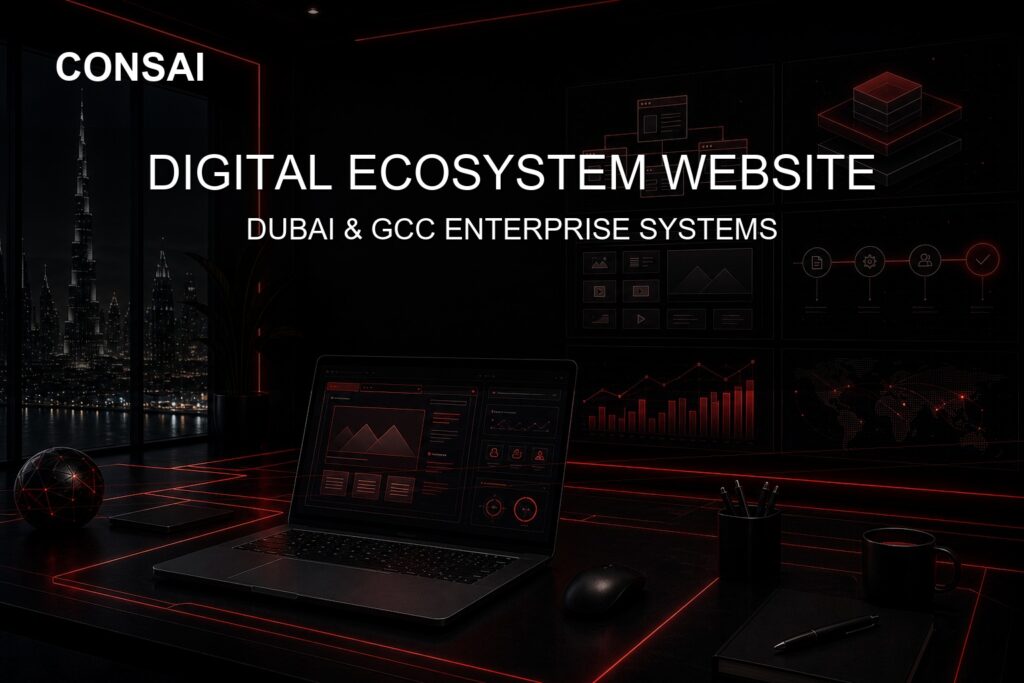
The modern approach is the digital ecosystem website Dubai model. Instead of building “pages,” you build a system that attracts the right visitors, guides them through clarity and trust, and turns them into inquiries that your team can actually follow up on. This is how websites become revenue assets, not cost centers.
And here is the uncomfortable truth: a website that is not connected to a process (lead capture, follow-up, CRM, and measurable conversion steps) will always underperform, no matter how good the design looks.
Digital Ecosystem Website Dubai for SEO, CRM and Automation
A digital ecosystem website connects content, service pages, proof, conversion paths, CRM, automation and analytics into one growth platform. CONSAI Agency builds this structure for companies that need the website to support real operations rather than sit online as a static brochure.
For Dubai and GCC businesses, this means each page has a role: attract demand, explain value, build trust, capture inquiries, route leads and support follow-up.
Website Ecosystems Connected to Revenue Infrastructure
CONSAI Agency connects architecture of growth, web architecture, SEO infrastructure, CRM operations and AI business automation.
What “Big Picture” Really Means for a Digital Ecosystem Website Dubai
“Big picture” does not mean “more pages.” It means designing your website like an ecosystem where each part has a job. Just like a well-run business, every component supports the next step.
A digital ecosystem website Dubai typically includes:
- Clear positioning: who you help, what problem you solve, and why you are different.
- Structured journeys: paths for different customer types (for example: SMEs, enterprise, startups, real estate, hospitality).
- Trust-building layers: proof, process transparency, risk reduction, and clear expectations.
- Conversion infrastructure: strong CTAs, forms, WhatsApp, calendar booking, and tracking.
- Follow-up system: CRM integration so leads do not vanish after the first message.
In other words, “big picture” is strategic clarity. It’s the difference between “a site that exists” and “a site that sells.”
What Every Website Must Include (Offer, Audience, Proof, Process)
Most websites fail because they skip fundamentals. If you want predictable lead flow in Dubai/GCC, these elements are non-negotiable.
1) Offer: A Specific Promise, Not a Service List
Instead of listing everything you can do, lead with outcomes. People buy results, not features. For example: “Increase qualified inquiries,” “Improve booking rates,” “Reduce manual operations,” or “Launch a conversion-ready website in 30 days.”
2) Target Audience: Say Who It’s For
Dubai is diverse. If you try to speak to everyone at once, you feel irrelevant to everyone. Define your audience segments clearly and show you understand their context (speed, compliance, multilingual customers, premium expectations, mobile-first behavior).
3) Proof: Risk Reduction Beats Hype
Proof is not “we are the best.” Proof is evidence that reduces doubt. Add:
- Case studies with measurable outcomes (leads, conversions, speed improvements)
- Testimonials with role and region (Dubai, Abu Dhabi, Riyadh, Doha)
- Relevant certifications or partner tools used (analytics, CRM, hosting)
For credibility and on-page quality principles, use Google’s guidance as a baseline:
Google: Creating Helpful Content.
4) Process: Explain What Happens After Contact
People hesitate when they can’t predict the next steps. A simple process section increases conversions because it removes uncertainty. Example:
- 15-minute discovery call
- Scope, timeline, and proposal
- Copy + structure aligned to conversion
- Design + development + performance
- Launch + tracking + optimization
For usability best practices that improve clarity, a respected UX resource is:
Nielsen Norman Group (UX research).
Why “20 Pages” Is Usually a Bad Idea
More pages do not equal more value. In most cases, “20 pages” is a symptom of indecision: everything gets written down because no one wants to prioritize. The result is a site that overwhelms visitors and confuses search engines.
Here’s what typically happens when a business builds too many pages:
- Navigation becomes a maze: visitors don’t know where to start.
- Content quality drops: thin pages get published just to fill the menu.
- SEO gets diluted: similar pages compete with each other and reduce topical authority.
- Maintenance becomes expensive: updates are avoided because there is too much to manage.
A better approach is fewer, stronger pages with clear intent: a conversion-ready homepage, focused service pages, a proof section (case studies), and one strong contact path. Build depth where it matters, not breadth where it wastes attention.
Example Funnel: Visitor → Trust → Inquiry → CRM
This is the ecosystem model in action. It’s not complicated, but it must be intentional.
Step 1: Visitor Arrives (Search, Ads, Social, Referral)
The landing page must immediately communicate what you do, who it is for, and what success looks like. The first 10 seconds decide everything.
Step 2: Trust Builds (Proof + Clarity)
Visitors scan for signals: results, credibility, and how confidently you explain your process. This is where you earn the right to ask for contact details.
Step 3: Inquiry Happens (Conversion Layer)
Use a primary CTA that matches Dubai behavior: WhatsApp, short forms, and fast scheduling. A weak “Contact” link is not a conversion plan.
Step 4: Lead Enters CRM (No Lost Opportunities)
Once a lead is captured, your system should categorize, assign, and follow up. This is where most businesses leak revenue: messages arrive, but no structured follow-up exists. An ecosystem website connects the front end (website) to the back end (CRM and sales workflow).
If you want to explore how we structure services and delivery, see:
https://consaiagency.com/our-services/
Why CONSAI Agency Is the Right Partner for Dubai & GCC Companies
- We build systems, not “just websites”: structure, CTAs, tracking, and follow-up aligned in one flow.
- Dubai/GCC buyer clarity: messaging and structure built for fast decisions, mobile traffic, and diverse audiences.
- Conversion and SEO together: we avoid the common trap of “SEO pages” that don’t convert.
- Operational readiness: CRM-ready lead capture so inquiries become measurable pipelines.
- Practical execution: fewer assumptions, more testing, clearer outcomes.
We Build the Ecosystem, Not Just Pages
If your current website feels like a brochure, you are leaving money on the table. Let’s turn it into a structured ecosystem that builds trust and generates consistent inquiries.
Start here: https://consaiagency.com/contact-us/
Website to Sales System Route
A digital ecosystem should connect website demand, CRM stages, qualification and follow-up. This page connects to AI outbound and inbound systems when the website must feed a structured revenue workflow.
Digital Ecosystem App Route
A digital ecosystem can include a mobile layer when repeat users, accounts, notifications and operational workflows need more than a website. This page connects to mobile app development.
Digital Ecosystem Web3 Route
A digital ecosystem can include identity, access, loyalty and asset logic when the business model requires it. This page connects to Web3 blockchain infrastructure for distributed-system planning.
-digital-ecosystem-website-dubai-big-picture-method
Founder Ecosystem Route
A digital ecosystem for a Dubai company should reflect the legal setup, operating model and market entry plan behind the business. This page connects to the business setup Dubai 2026 founder systems guide.
-digital-ecosystem-website-dubai-big-picture-method-zero-tax
Tax-Aware Digital Ecosystem Route
Business ecosystems in Dubai should align digital operations with tax positioning, compliance and cross-border growth planning. This page connects to the zero tax business Dubai 2026 guide.
Related CONSAI insights
Continue through the connected strategy layer with practical guidance on AI, automation, CRM, digital infrastructure and GCC growth systems.
- RWA Tokenization Dubai | Web3 Asset Infrastructure for Investors & Business Owners
- Conversion Setup Dubai Case Study
- Digital Assistant Website Dubai Guide
- Landing Page vs Website Dubai | Growth Structure | CONSAI
- Conversion Focused Web Design Dubai | Lead Systems | CONSAI
- Conversion Copywriting Dubai | Generate Leads
- Digital Growth Dubai 2026 | AI Revenue Systems | CONSAI
- Website Navigation Optimization Dubai | UX SEO | CONSAI